


Lovro Rakar has always been surrounded by talented colleagues with countless ideas, so it was only natural for him to develop a games console for his graduation assignment. His professor, impressed by the product, encouraged him to present its operation and the entire manufacturing process at the MIDEM International Conference and later at the MOS fair in Celje.
This was the first time that Lovro had delved into the engineering skills. "I like that!" he said to himself.
The band, which evolved from the scouts, has been playing around Slovenia for several years. Time and again, they had problems with the drum set-up and the sound system. If you have it in your blood to find solutions, you look for them with every problem... At first, they solved the problem with a kahon - a percussion instrument suitable for smaller spaces, but which has very few different sounds. Could you do better than that? How could you get more sounds out of this small kahon?
Lovro assembled the first prototype a few hours before the band's performance. He glued some piezzo sensors to the kahon and connected them to the digital interface of an old electronic drum kit. Spil was a success, and a friend of mine was also enthusiastic about the idea and the sound. Jernej Jezeršek.
When they were given the task of developing and presenting a business idea in an economics course at the IAM, Lovro immediately raised his hand: 'I have an idea! In fact, I already have a product! The most advanced cajon sound amplifier." This is how he first became acquainted with business model design. At the end of the semester, Lovro asked his economics professor Eneja Gradiška, if I became his mentor and helped him refine his business model for the POPRI competition. He was happy to help and after three months of hard work, the Nejc, Mihael and Lovro with OnStage (now Algorythmo) win the 20th POPRI National Competition.

Immediately afterwards, he contacted Catapult and impressed from the very first presentation. Jure commented after his performance, "He's going to be a match for this one."
Jure helped them with the first tips on how to make the enclosure and what processors to use. Then other experts at Dewesoft helped them, especially in the field of electronics. It is a big challenge to make a functional circuit where there is no noise.
They are particularly keen to highlight Saša Piskar - a musician who knows how to measure - who could be better than that. They were advised on what platform, what chips, what circuits to use... Thank you, Dewesoft, for all the useful information!
In general, they found many parallels with Dewesoft. "It has grown on us. They deal with analogue signal processing, i.e. measuring instruments, and we deal with very similar things, except that we call the analogue signal sound."
With the help of Catapult Metal the casing has been completed. "It's the first time someone has told us in such a practical way - you have this machine here, you need that machine for the casing..."
10 minutes later, he was holding the case in his hand. "They stopped the production process for the one piece I had to get. I was quite a bit touched ..." Not only that, but he was also linked to B&M for eluxing and sandblasting. "But you're from the Catapult? We'll do it for free." And he was moved again.
They also joined the Sas Incubator programme, and later got 2nd place at the Rector's Award of the University of Ljubljana.

The first prototype batches are now in the stage of being delivered to the first users for testing. Two friends were also instrumental in the design of the MSP circuit Andraž Balantič and Marko Klobčarwho helped colleagues create a modular circuit that allows for rapid upgrades and iterations.
Lovro, where did you get such a passion for creativity, for entrepreneurship? "I like to do things that give me meaning. The fact that at the end there is a product that I can hold in my hands and see what I have created. We can do things like this late into the night. Sometimes we just forget about the time and we're up until five in the morning working, developing, looking for solutions, whatever. When it makes sense, it's not difficult.
The other important thing for me is to work with extremely talented people. I love being around them because they improve and inspire me. It's the only way we've managed to get to where we are."
What advice would you give to those who have an idea but have not yet actively started to implement it? "It's a bit lame for me to say do something that makes you happy. I prefer to say do things that give you meaning. That way you won't run out of energy easily.
In Slovenia, we have plenty of opportunities to develop our ideas. Surround yourself with people who have that glow. You just get infected with it..."
What if we are afraid to start? If we don't know if we are up for entrepreneurship? "I'm sure everyone has solved a problem they wanted to solve. This is it. That's entrepreneurship at the end of the day."
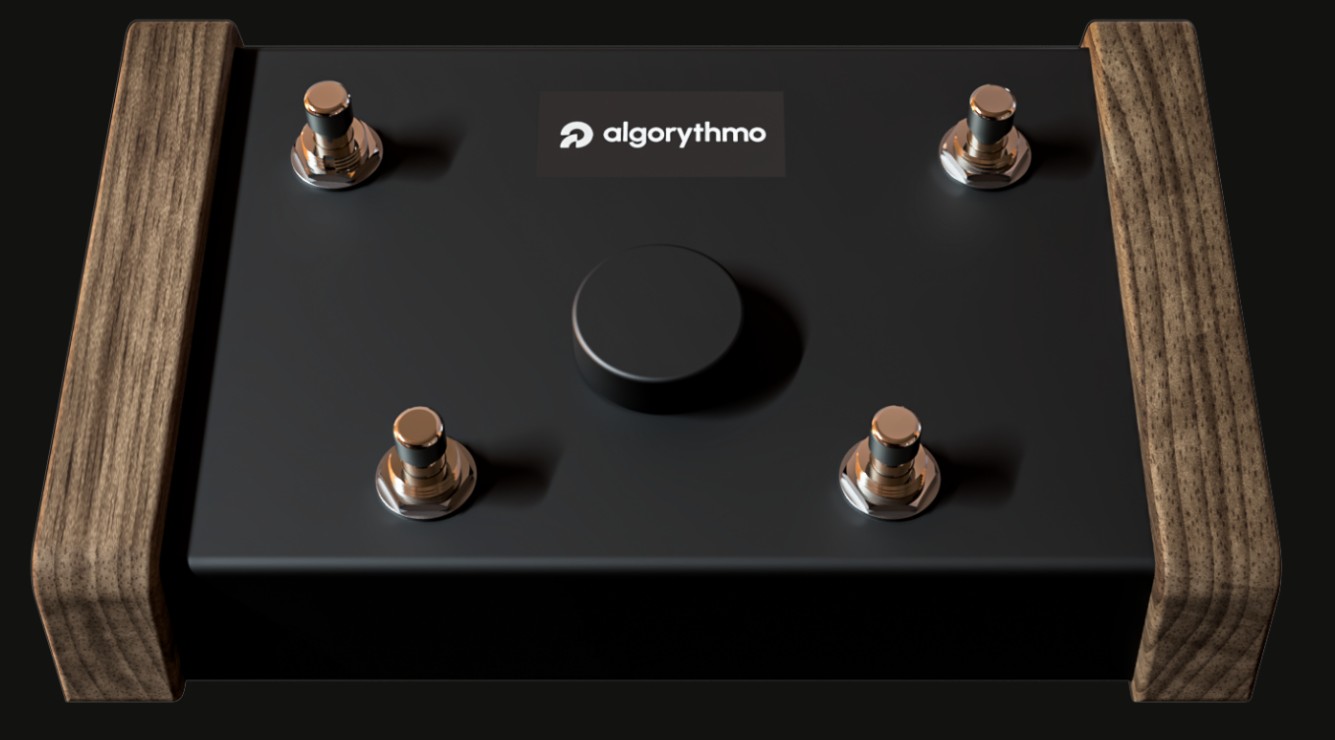
You can follow the Algorythmo project on the website Algorythmo.comwhere you can pre-order the product, subscribe to Algorythmo's news and innovations.