


"Oh... But you're going to make a rocket? Great, great ... nice that you have a dream," the mayor patted them on the shoulder. He nodded and nodded to their enthusiastic explanation about rockets, but when it came to the space the 20-year-olds desperately needed for such a feat, he just shrugged. We don't. He didn't understand that it was about technological progress and therefore good publicity for his city. There is no room for such crazy daydreaming.
But they urgently needed space for their SPACELINK Institute to develop a rocket!
"Our idea at the time was quite ambitious. We were developing a launch system (rocket) that would significantly reduce the cost of microgravity experiments in the marketplace and launch small payloads such as nano and microsatellites - lowering the barrier to entry and making space accessible to smaller organisations with limited resources such as research institutes, universities and private companies. Otherwise, for larger launches, larger satellites or larger payloads are favoured when leasing capacity; smaller payloads are only an option when there is spare capacity on the payload, and when they do finally come on line, the prices per kilogram are extremely high.
The rocket engine would use an innovative hybrid propulsion technology, roughly paraffin wax as a fuel and liquid oxygen as an oxidant," explained Jureto Knez at Katapult at the time.
Jureto's first comment was: "I think the idea is crazy." In a good way.
All the follow-up questions were not 'why not', but just 'how to really do it'. They found a partner, they found a place and they found an ecosystem that had the understanding and even some of the initial investment to develop a rocket.
This highly ambitious Student project Spacelink is co-founded by Vid Selic, then a 22-year-old boy, together with a colleague from the Faculty of Mechanical Engineering in Ljubljana, and the team was made up of other colleagues from engineering backgrounds, including mechanical, electrical and chemical engineers.
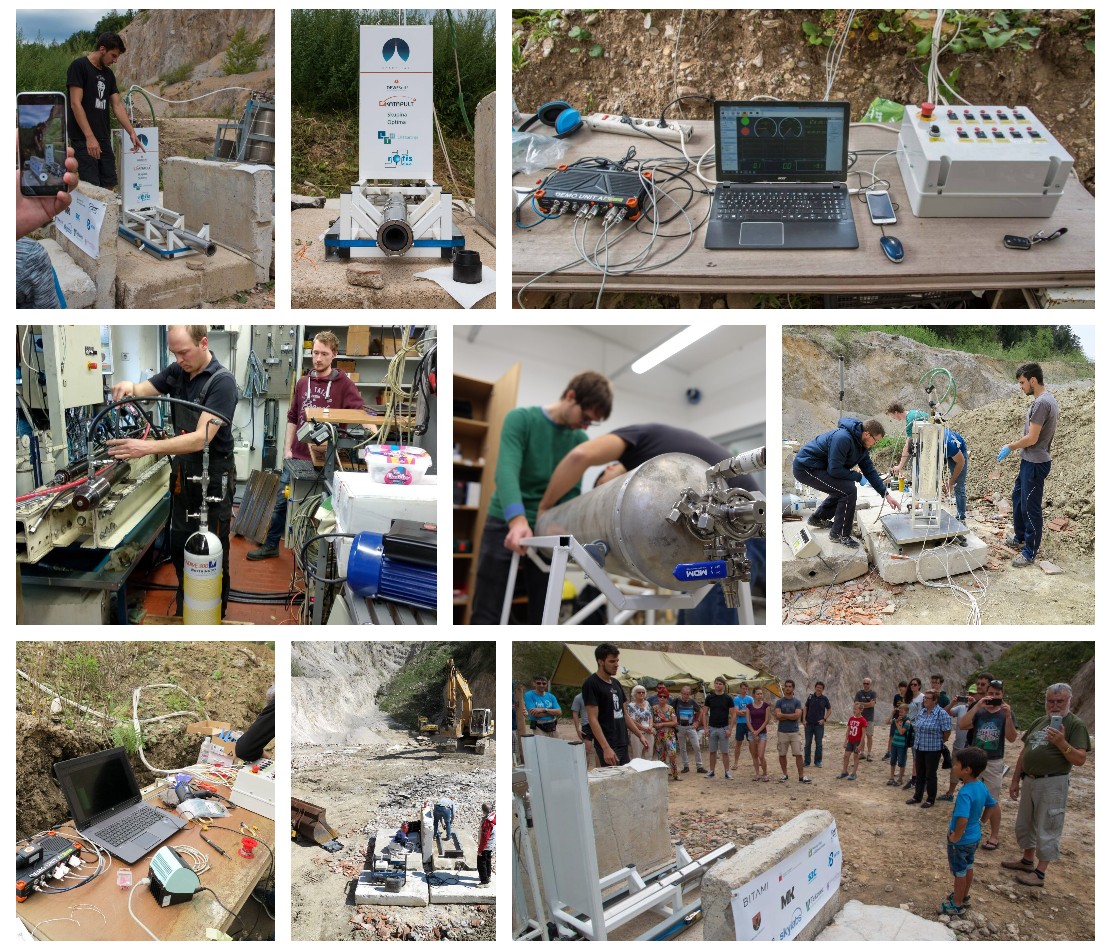
They have successfully taken the development to the stage of a static test of a full-scale engine, such as the one that would later equip their first rocket, which is expected to rise to an altitude of 20 km with an estimated 3000 N of thrust. This rocket, Stella 1, would serve mainly for in-flight validation of the technology before "upscaling" to a final rocket size, equipped with active stabilisation, capable of exceeding 100 km (the Karman separation distance) and, later, of "tracking" a nano-satellite into a lower Earth orbit.
They had the necessary know-how, endless enthusiasm, even a top-notch idea, but probably a digit or two more in investment was missing. They were competing with global companies with multi-million dollar budgets. The components are extremely expensive, they had to develop key parts themselves, and that is the only way to offer a better product than the competition. The hard-earned start-up money was being eaten up as if it were being burned in a furnace. They had people in the team who later completed their PhDs, the most ambitious students. So people with a lot of knowledge. They did not have the money to reward them properly and, as an institute, they could not even pay out prizes. What could they possibly do?
At this point, the founders were not united on how to overcome the challenge, so Vid turned to Jureto for advice.
Few words were exchanged in that conversation before Jure suggested: "Come and work at Dewesoft."
There are few defining moments in life that make your heart skip a beat as much as it did for Vidu. "To be honest, I didn't know about Dewesoft until Spacelink and I were in Katapult. When I saw this high-tech company here, somewhere hidden in a valley, I had the feeling that the whole environment of this company was of a high standard. Not only the infrastructure, but also the energy, the prevailing engineering mindset, the focus, the agility... But one day in the future I would like to work here... I said to myself at the time. But I didn't really think at the time that a few years later I would get an offer like that. Of course I grabbed it - immediately! No brainer.
When can I start?"
He was already at Dewesoft on Monday.
Today Product Manager with the aim of keeping products alive for as long as possible to avoid losing market value. In this way, it aligns development with market needs and ensures that products are directly applicable to the challenges and problems faced by Dewesoft's customers.
What did Vid Selič learn from the Spacelink story?
"If you always play ziheras, you will always walk down the middle. It's worth taking a little risk and going the unconventional route. That's the biggest lesson." Sometimes it doesn't lead you exactly where you wanted to go, but it certainly opens interesting doors you hadn't thought of.
Over time, other members of the team also got good offers for collaborations and jobs in their industry. "Well, isn't it logical - if you hear that some students are putting together some kind of rocket on their own - but as an employer, wouldn't you grab it quickly? I would." If an individual's activities create a proper separation from others on the job market and, above all, show initiative, they are immediately more interesting to the labour market.
What have the other team members learned? "I hope they have learnt that you can dream in a crazy way. To go a little out of your comfort zone. It's not that hard to go on a wild adventure. Just make up your mind - let's build a rocket, launch it, and see where it takes us. It's often hard to predict the final outcome in detail in advance, the only way is to go for it. If you have a passion in your heart for something, you're already off to a good start."
They had the ideal environment for raw engineering solutions to problems that you can't plan for in advance. Throughout the development of the project, they acquired a number of general skills relevant to business and to leadership positions in the workplace in general - negotiating, dealing, public speaking, finding solutions, understanding the business, working hard, etc.
Does he ever regret that they got this far but did not develop the rocket further?
"It goes against my outlook on life. If you think you've made a mistake, you have to evaluate it and learn from it. If you regret it, you're just wasting yourself, there's no hask from it. And - look where it got me! Isn't that success in the end? I have so many cool memories of that time..."
In Velenje, a quarry has been approved to carry out tests for a rocket engine. Liquid oxygen had to be brought there. Easy? Well, not really. They didn't have the right container, which is specifically designed to carry liquid oxygen, and they didn't have the money to buy one. They borrowed a tank, loaded it onto a trailer and hitched it to an old Golf. They had previously calculated how long it would take for the liquid oxygen to evaporate and concluded that they could easily leave it in the quarry overnight. "If memory serves, we didn't take into account that evaporation happens faster and faster because the mass of residual oxygen in the container is constantly decreasing, and is therefore heated more quickly by external influences." The next day, they arrived as planned to test the rocket engine and ... the oxygen tank was empty. And they loaded the tank back on the trailer ... Let's try again.
Another time they came to the Catapult to cast wax for the fuel cassettes. Everything was ready. Well, almost everything. The wax supply was estimated too optimistically. Vid quickly asked Google where there was a candle maker and found one in Zagorje. "Good day," he was there half an hour later. "We'd like to buy a bag of wax." The master just stopped working. A bag of wax? "Yes." Just one bag of raw wax? "Yes. We're working on a rocket, but we've got to get it into the hatch somehow." Oh, a rocket, you say... "You know what," said the gentleman, who had been looking at the young man for quite a long time, probably wondering if this was some kind of joke, "what you've told me is so funny that I'm going to give you this sack of wax. Here, I'll give you two bags." And they got wax. Even better than before, when they bought it deliberately for the tests.
Today, Vid Selič is also a mentor at Katapult. With her experience as a start-up owner and now as a leader at Dewesoft, she can save those at the beginning of their business journey a lot of complications and inspire with her story.
What advice would you give to young people today?
"I tell them the same thing all the time - no one will invite you to succeed. You can be the best student by objective standards, but if you don't initiate yourself, you will always be in the crowd. You have to choose your own path, you have to walk towards success. No one is going to pave that path for you and invite you to it. That is how human nature works. Then dare to take the risk. Try! If you don't try, you won't know."